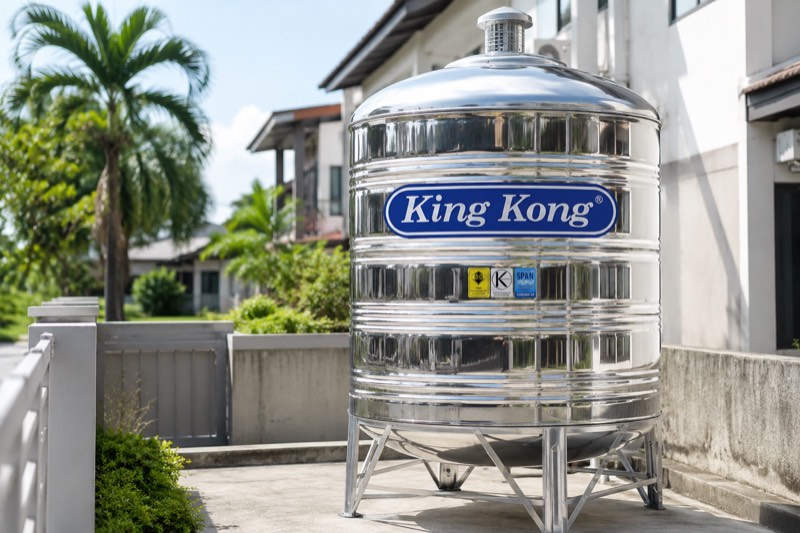
Shopping for a new water tank but confused by the options? There are three types of water tanks most commonly found in Malaysian homes — stainless steel, poly (polyethylene plastic) and fibreglass. Each one has its place; what matters is that you understand the differences before you spend your money.
This guide compares all three types on durability, water quality, price and how well they suit the Malaysian climate.
Stainless Steel Water Tanks
Stainless steel tanks — like the King Kong Water Tank we install — are made from SUS-grade rust-resistant steel sheets. This is the most popular choice for new homes and upgrades because of its durability: it does not rust, does not grow algae easily, and the smooth inner surface makes cleaning simple.
Main advantages: a long service life, water that stays clean (the tank does not absorb odours or colour), it withstands the scorching Malaysian heat without turning brittle, and it simply looks neat. Drawbacks: the price is higher than poly, and for coastal areas you need the right stainless grade to withstand the salty air.
Poly Water Tanks (Polytank)
Poly water tanks or polytanks — usually blue, orange or black — are made from polyethylene. This is the type most commonly installed by developers in new housing projects because the cost is low and installation is easy.
Advantages: the cheapest price, light weight, and plenty of size options. Drawbacks: the plastic can turn brittle after years of UV exposure, dark colours absorb heat until the water runs warm in the middle of the day, and the inner surface grows algae more easily if it is not cleaned regularly. A blue water tank whose colour has faded is usually a sign it is getting old.
Fibreglass Water Tanks
Fibreglass water tanks are made from glass fibre layered with resin. They used to be popular for homes and commercial buildings, but are now less common in the residential market compared to poly and stainless steel.
Advantages: sturdy, rust-proof, and can be manufactured in large sizes. Drawbacks: if the inner lining cracks, glass fibres can end up in your water; repairs are more complicated; and quality depends heavily on the manufacturer.
If your house still runs on an old fibreglass tank that is in good condition, there is no need to rush a replacement — but when it starts giving problems, most homeowners today jump straight to stainless steel rather than buying a new fibreglass unit, because the price gap is no longer big and residential fibreglass options are getting scarce in the market.
Black vs Blue Water Tanks: What Does the Colour Mean?
The colour of a poly tank is not just a matter of looks. Black water tanks are designed to block sunlight from penetrating the tank walls — less light means less algae growing inside. The downside is that black absorbs the most heat, so the water can turn warm at midday if the tank sits in direct sun.
Blue and orange tanks are the ones most commonly installed by developers. Lighter colours absorb less heat, but more light gets through — which is why a blue tank that is rarely cleaned grows algae on the inside faster. When the blue has faded to a chalky greyish-white and the surface feels powdery to the touch, that is a sign the plastic has been eaten by UV for years and is starting to turn brittle.
With a stainless steel tank, this whole colour issue simply disappears — the steel walls let no light through at all and the outer surface reflects heat. That is one of the reasons water from a stainless tank stays cooler and cleaner without you having to think about colour at all.
Water Tank Prices by Type: What Drives the Real Cost
When comparing water tank prices, make sure you are comparing the same thing. The price at the hardware shop is usually for the bare tank only — before delivery, installation work, the float valve, pipe connections and disposal of your old tank. A number that looks cheap can balloon once all of these costs get added one by one at the end.
The factors that determine price: material (stainless steel costs more than poly), the grade and thickness of the material, capacity, brand, and the site work your house needs. Two houses buying the exact same tank can end up with different costs simply because one needs a new stand and the other does not.
That is why at Abang Tank we quote a fully installed price: one number, everything included, confirmed after a free site visit — so you never have to guess what is hiding behind the quote.
Which One Should You Choose?
For most Malaysian homes today, a stainless steel water tank is the most balanced choice — long-lasting, clean water, and worth it over the long run even though the upfront price is higher. That is why the main Abang Tank package uses the King Kong Water Tank 1000L stainless steel, fully installed at RM 2,914.
Poly still makes sense if the budget is tight or for temporary use. And if you already have your own poly or fibreglass tank in good condition, we can install it for you — installation-only at RM 1,350, including a 6-month installation warranty.
The easiest way to decide: work out how long you plan to stay in the house. Five years or less, poly may be enough. Is this the family forever-home? Choose once, choose the one that lasts — so the tank is no longer something you have to think about every hot season.
FAQ — types of water tanks
How long does a stainless steel water tank last?
With normal care, a quality stainless steel tank lasts far longer than poly — typically well over a decade without any rust problems.
Why are poly water tanks so much cheaper than stainless steel?
Raw polyethylene plastic is far cheaper than rust-resistant steel, and the manufacturing process is simpler. The low price comes with a shorter service life.
Can I swap an old poly tank for stainless steel using my existing pipes?
In most cases, yes — we adapt your existing pipe connections during installation. The free site visit will confirm exactly what is needed.
Are black water tanks better than blue ones?
For controlling algae, yes — the black walls block light from getting in. But they absorb more heat. Both are still poly plastic with the same lifespan; if you want to solve the algae and heat issues in one go, stainless steel is the answer.
Read Next
→ Water Tank Size for Your Home: How Many Litres Does Your Family Need?→ Home Water Tank System: Function, Components & How It Works