Noise coming from the direction of your water tank — especially in the quiet of the night — is genuinely annoying. Knocking in the pipes, a faint humming, or the sound of water dripping that never stops. Each type of noise is actually a clue pointing to a different problem.
Here are the four most common causes and how to fix each one — most of them you can identify yourself before calling anyone in for water tank repair.
1. Continuous Dripping Or Running Water Sound
The most common cause: the float valve is not sealing properly, so water trickles in non-stop and escapes through the overflow. Beyond wasting water, this is a sign the valve washer has worn out or the float arm needs adjusting. The fix: check and replace the float valve or the valve washer.
How to confirm it: close every water point in the house, then listen closely at the tank. If after a few minutes you can still hear water entering, the float valve is not shutting fully. Also check the end of the overflow pipe from outside the house — a continuous drip there is the clearest confirmation, and it shows up in your water bill every single month.
2. Pipe Knocking (Water Hammer)
Loud knocking when a tap shuts suddenly — washing machines and solenoid valves are the usual triggers. Water pressure stopping abruptly sends a shockwave down the length of the pipe. The fix: install a water hammer arrestor or adjust the pressure; loose pipes also need to be tightened at their brackets.
Simple test: open a tap and close it slowly — if the knocking does not appear, the cause really is the sudden shut-off. Also note when the noise happens: if it is every time the washing machine stops filling, a small arrestor fitted directly at the machine’s inlet valve is usually enough to solve it.
3. Humming Or Vibration
A continuous hum usually comes from a half-open valve vibrating with the flow, or — if your house has a pump — from a pump working more often than it should. A pump that keeps switching on and off (short cycling) signals a pressure problem or a small hidden leak somewhere in the system.
To trace the cause: fully open each valve along the supply line one by one and listen for any change in the hum. If your house has a pump, watch how often it starts when nobody is using water — a pump that runs by itself with zero usage means water is "disappearing" somewhere in the system, and that needs tracking down before it becomes a major leak.
4. Cracking Or Stretching Sounds
Poly tanks expand and contract with temperature changes — soft cracking sounds in the midday heat are the plastic stretching. Occasionally this is normal; but if it comes with visible hairline cracks or a change in the tank body’s shape, that is a warning the tank has turned brittle and should be inspected. Also look at the tank surface: poly that has been exposed to the sun for years turns faded and chalky when you run your hand over it — a sign the material has weakened from the outside.
If the noise arrives together with other problems — dropping pressure, murky water, or signs of a leak — do not wait. Abang Tank’s free site visit covers the tank, float valve and piping in one inspection; we tell you the cause and your options straight away.
Fixing A Noisy Water Tank: DIY Inspection Steps
Before calling anyone, spend ten minutes on these basic checks. The information you gather shortens the diagnosis — and sometimes solves the problem outright without spending a single sen. Bring this list up to the tank along with a torchlight:
- Identify the noise pattern: continuous, only when a tap closes, or only in the midday heat — each pattern points to a different cause.
- Open the water tank cover and watch the float valve while the tank fills — does it shut fully and silently?
- Check the end of the overflow pipe for a continuous drip.
- Touch the pipes while the noise is happening — vibration in your hand shows the path the noise is travelling along.
- Note which water point triggers the noise: washing machine, shower, or toilet.
Proper Water Tank Installation: Preventing Noise From Day One
Most tank noise actually originates from the installation, not from the tank. A properly done home water tank installation takes care of the things that prevent noise from the start: pipes clamped neatly at the correct intervals so they cannot vibrate freely, a quality float valve installed and tested to shut silently, and a level base so the tank never has to "work" against a tilted position each time it fills.
The pipe connections into the tank matter too — a connection under tension or out of alignment sends every flow vibration straight into the tank body, which acts like a sound box. A proper installation leaves the pipe runs aligned and free of tension.
This is why a tank installed properly from day one rarely "talks" — and why we confidently put a 6-month installation warranty on every Abang Tank job.
Noise + Tank Age: When Replacing The Tank Makes More Sense
If your poly tank is years old and the heat-cracking sounds are getting more frequent — let alone if they come with discolouration, a chalky surface or a shape that is no longer round — the cost of patching and repairing it over and over usually is not worth it. Every repair merely postpones a replacement that is coming anyway.
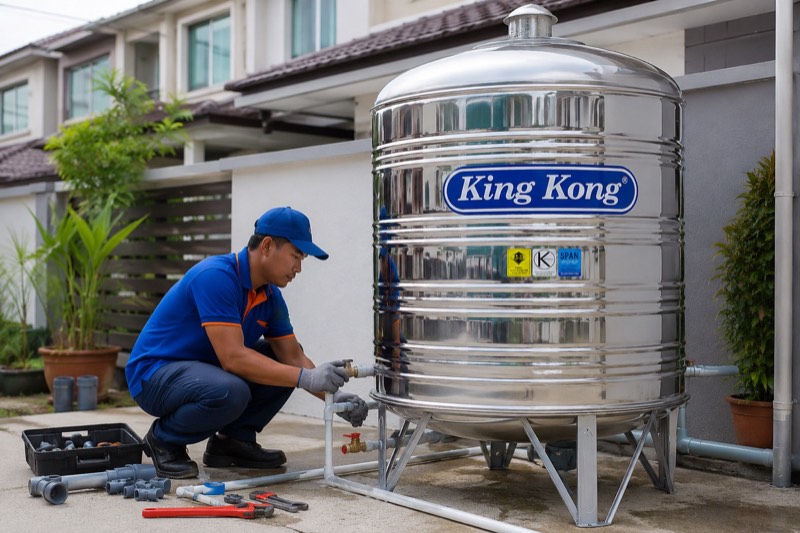
A stainless steel water tank does not go through the stretch-and-shrink cycle that poly does, so heat-cracking noise is a non-issue — and its lifespan is far longer. The King Kong Water Tank 1000L stainless steel with Abang Tank is RM 2,914 fully installed — an all-in price, complete with a 6-month installation warranty. Many customers choose to replace outright once the old tank starts "talking" too often.
FAQ — water tank repair
My water tank makes knocking sounds at night — is it dangerous?
Water hammer is not immediately dangerous, but over time it loosens pipe connections. Best to install an arrestor before it causes a leak.
Why is the noise louder at night?
At night the incoming mains pressure is higher (lower usage across your area) and the surroundings are quiet — the same noise simply becomes more noticeable.
The noise stopped on its own — should I still get it checked?
Noise that comes and goes is usually linked to fluctuating pressure. The underlying cause is still there — a quick inspection is cheaper than damage discovered late.
Read Next
→ Water Tank Float Valve: How It Works, Common Problems & When to Replace→ How To Increase Water Pressure From Your Tank: 5 Fixes By Cause