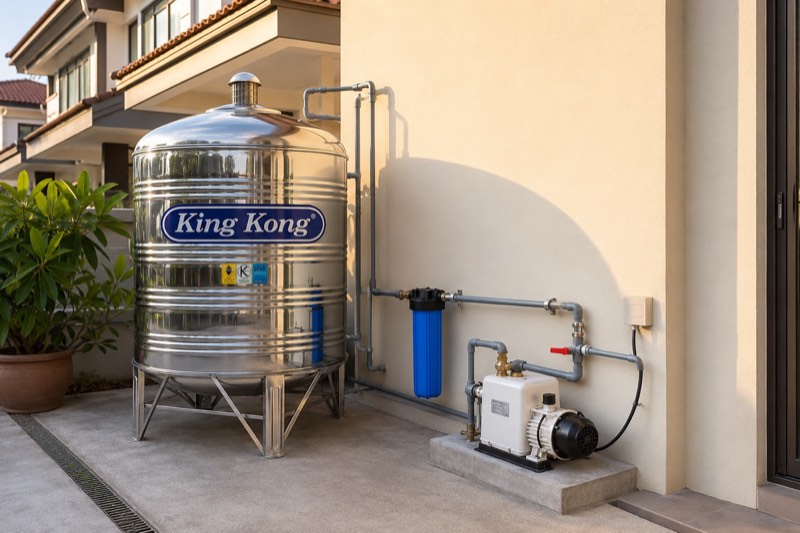
Malaysia receives some of the highest rainfall in the world — thousands of litres of water fall for free onto your roof every month. A rain water harvesting tank captures a portion of it for reuse. But is this system actually worth it for an ordinary home?
Let’s look at how it works, which uses make sense, and the honest maths — so your decision is based on facts, not just the appeal of the idea.
How A Rain Water Harvesting System Works
The concept is straightforward: rainwater from the roof flows through the gutters into a coarse filter (screening out leaves and debris), then into a dedicated storage tank. A first-flush diverter discards the first minute of rainfall — the dirtiest portion — before clean water enters storage.
The harvested water is then pumped or gravity-fed for non-drinking uses: watering the garden, washing the car, cleaning outdoor areas, and toilet flushing.
The part that determines the quality of the whole system is that filtering sequence: coarse mesh at the gutter holds back leaves, the first-flush discards the initial roof wash (dust, bird droppings, grime accumulated since the last rain), and only then does water enter storage. Skip any of these stages and the system ends up with a muddy tank within a few months.
Suitable Uses (And Unsuitable Ones)
Untreated rainwater is NOT suitable for drinking or cooking. Its practical uses in a Malaysian home: garden and landscape watering, washing vehicles and outdoor areas, and toilet flushing — uses that can account for a large share of daily water consumption in a house with a garden.
For homes with a large garden or a pond, the savings on the water bill can be significant. For apartments or homes without outdoor areas, the system is far less relevant.
One more use that many people overlook: emergency storage for non-drinking needs. During a prolonged supply disruption, harvested water can handle toilet flushing and washing — leaving your main tank’s storage reserved for bathing and cooking. Two tanks, two roles, and your household lasts much longer.
What You Will Need
A basic system requires: suitable roof area and gutters, a separate storage tank (never mix it with your main supply tank), filters and a first-flush diverter, plus distribution piping to the points of use. The harvesting tank must be tightly sealed — open standing water is an invitation to Aedes mosquitoes.
Important: a harvesting system is a complement, not a replacement for your home’s main supply tank. Your main tank still needs to be correctly sized and in good condition for daily supply.
In terms of installation work, what eats up the most time is not the tank — it is the routing: connecting the gutters to the filter, laying out distribution pipes to the points of use, and making sure the harvesting tank’s overflow is channelled properly into the drain so it does not pool around the base. Plan this routing on paper first before buying any equipment.
Home Water Tank Capacity vs Harvesting Tank: How Big Do You Need?
A harvesting tank is not sized by the same formula as your main supply tank. The main tank is sized by the number of occupants and daily needs — which is why typical home water tank capacity in Malaysia hovers around 1000 litres. A harvesting tank, on the other hand, is sized by three things: how often you use water outdoors, how much roof area is catching rain, and how much ground space you have available.
A practical way to think about it: list out your outdoor usage across a week — watering the garden every evening? Washing the car on weekends? Hosing down the yard periodically? If your outdoor usage is frequent, a larger harvesting tank means you rarely run out of stored water in the middle of a short dry spell. If your usage is only occasional, a medium tank is plenty — a big one would just sit half-empty.
Placement matters too: a harvesting tank is most practical positioned close to a gutter downpipe, on a level base that follows the same principles as any tank base — level, solid, and weather-resistant.
Harvesting Tank Guidelines: Safety & Upkeep
The most important rule: the harvesting system must stay completely separated from your drinking water supply. Never connect harvesting pipes directly to the mains supply piping — backflow risk can contaminate your home’s clean water. Good practice is to label the harvesting distribution pipes clearly ("NOT DRINKING WATER") so that anyone doing pipe work in future never connects them by mistake.
Aedes prevention is not optional — it is an obligation. The harvesting tank must be tightly covered, inlet and overflow openings fitted with fine mesh, and gutters checked so no water sits stagnant. A tank left open by even an inch becomes a mosquito breeding ground within days.
A realistic upkeep schedule: empty the first-flush diverter as per the installation instructions, clean the coarse filter after heavy monsoon periods (leaves and sand accumulate the most then), and check for sediment in the tank every time you clean your main tank — one job covers both.
So, Is It Worth It?
Worth it if: you have a garden or frequent outdoor usage, sufficient roof and ground space, and you are willing to maintain the filters regularly. Less worth it if outdoor usage is minimal — the payback period becomes far too long. Do the honest maths yourself: how often do you actually water the garden or wash the car at home? That answer is what decides it, not the appeal of "free water".
Many of our customers start by getting the main supply system right first — a correctly sized, properly installed main tank — before adding a harvesting system. That is the order we recommend too: daily supply first, savings later. Want both assessed in one go? WhatsApp Abang Tank; our free site visit includes a full configuration recommendation for your home.
FAQ — rain water harvesting tank
Can rainwater be drunk after filtering?
With basic filtration — no. Drinking water requires comprehensive treatment. Use harvested water for outdoor purposes and toilet flushing only.
Does a harvesting tank need cleaning too?
Yes — filters are cleaned regularly, and the tank checked for sediment. The first-flush diverter also needs emptying on schedule.
Can I use an ordinary water tank for rain harvesting?
Physically yes, but a proper harvesting system needs filtration and full separation from the main supply. Get installation advice so the system stays safe.
Read Next
→ Home Water Tank System: Function, Components & How It Works→ Types of Water Tanks in Malaysia: Stainless Steel, Poly & Fibreglass — Which Is Best?