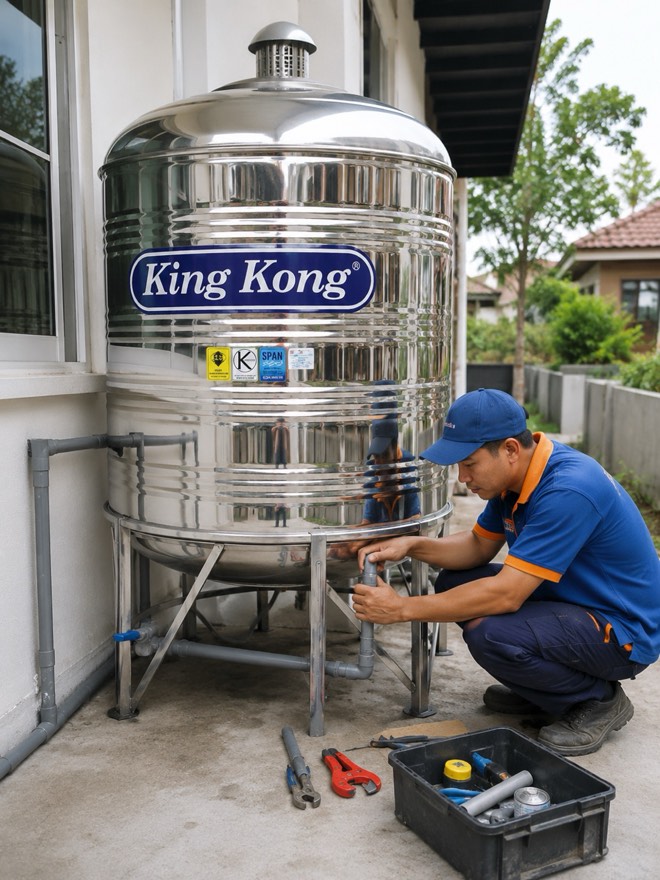
A full 1000-litre water tank weighs close to one tonne — imagine parking a small car on top of your house structure. That is why the water tank base is no small matter: a weak or uneven foundation is the root cause of early tank cracks, tilting, and in the worst cases, collapse.
This guide explains the types of bases and stands commonly used in Malaysia, how to tell whether your existing base is still safe, and when you need to build a new one.
Types Of Water Tank Bases & Stands
There are three basic setups most commonly used for home water tanks: a concrete base on the ground (for kampung houses and ground-level tanks), a galvanised steel stand (for terrace houses — in the back or side yard), and an existing concrete platform on top of the porch roof or a dedicated tank space.
Steel stands must be made of galvanised material or coated with anti-rust paint — a rusty stand is a ticking time bomb that many homeowners never notice until it is too late.
For double-storey terrace houses, the tank usually sits on a concrete platform in a dedicated space above the ceiling or on a flat roof. This type of platform is designed together with the house structure, so it is usually the most stable — but the age of the building, signs of water seepage, and hairline cracks in the concrete need to be checked before a new, heavier tank is lifted onto it.
What Makes A Base Safe
The core principle is simple: level, solid, and able to carry the full weight of the tank continuously.
Remember: the tank fills and empties every single day, so the base carries a load that keeps changing — not a static load. A base that "passes" a one or two day test will not necessarily stay sound after years of this cycle. That is why the criteria below must all be met, not just some of them:
- Completely level surface — a tilted tank suffers uneven stress and cracks much sooner.
- Base slightly larger than the tank diameter — the edge of the tank must never overhang.
- Weather-resistant materials — concrete or galvanised steel, never timber that will rot.
- Access for maintenance — enough room to check the pipes and float valve.
How To Build A New Water Tank Base
For a concrete base on the ground: the area is excavated and levelled, a layer of crusher run is compacted, then concrete is poured at a thickness appropriate to the tank size. The concrete needs time to cure fully before the tank goes up — this is work that cannot be rushed.
For a steel stand: the height is determined by your house’s gravity pressure requirements, then the frame is fabricated and anchored to the existing structure. Getting the height right here directly affects how strong the water flow will be throughout your house.
The most common DIY mistake: concrete poured straight onto soft soil without a compacted base layer underneath. It looks fine for the first month, but once the rainy season arrives, the soil below settles unevenly and the base starts tilting together with the tank on top of it. That compacted crusher run layer is not an optional step — it is what spreads that one tonne of weight evenly into the ground.
Water Tank Stand: The Right Height & Materials
For terrace and semi-D houses, a water tank stand is the most practical option — it raises the tank to a height that provides sufficient gravity pressure without major concrete work. The stand height is determined by the highest water point in your house: if you want strong flow at the upstairs shower, the tank has to sit high enough above it. Establish this requirement first, then choose the stand design.
Materials are non-negotiable. Galvanised hollow steel or angle bar with anti-rust coating is the correct standard; every joint must be fully welded, not just tack welded. The stand legs need to sit on a hard surface and be anchored so they cannot shift — a wobbly stand transmits stress into the pipe connections every time the tank fills and empties.
One thing that constantly gets overlooked: the weight difference between an empty tank and a full one. A stand that looks "strong enough" while the tank is empty is not necessarily safe once nearly a tonne of water goes in. If in doubt, have a licensed plumber assess it first — this check is included in Abang Tank’s free site visit.
Pre-Installation Checklist For Your Water Tank
Before a new tank is lifted onto its base, this is the checklist our team runs through every single time. You can use the same list to evaluate any contractor’s work:
- Base or stand confirmed level with a spirit level — never just eyeballed.
- Surface cleared of small stones and debris that could press into the tank bottom.
- Inlet, outlet and overflow pipe routes planned before the tank is placed — not forced around the tank’s position afterwards.
- Enough working space around the tank for future float valve checks and cleaning.
- Supporting structure below (porch roof, beams, platform) confirmed able to carry the full tank weight continuously.
Existing Base: Reuse Or Rebuild?
If you are replacing an old tank, the existing base needs checking first: any cracks in the concrete? Rust on the stand? Signs of settling on one side? If yes, putting a new tank on a problematic base simply transfers the old problem to the new tank.
During the free site visit, the Abang Tank team inspects the base together with the tank — if the base is still sound, we use it as is; if it needs work, we quote clearly before starting anything. Proper tank installation on a proper base is exactly what lets us stand confidently behind our 6-month installation warranty. For a sense of cost: the King Kong Water Tank 1000L stainless steel is RM 2,914 fully installed — an all-in price covering both tank and installation. If you already have your own tank, the installation-only fee is just RM 1,350.
FAQ — water tank stand
How much does it cost to build a water tank base?
It depends on the type (concrete vs steel stand), size, and site conditions. We quote it separately and transparently after the free site visit — before any work begins.
Can I just place a water tank directly on the ground without a base?
Not recommended — soil settles unevenly and causes the tank to tilt and crack. At minimum you need a compacted, levelled base layer.
How long does a steel water tank stand last?
A quality galvanised stand lasts many years. What needs watching is rust at the welds and legs — check them every time you clean your tank.
Read Next
→ How to Install a Home Water Tank: Full Process, Base Work & Cost Estimate→ Water Tank Size for Your Home: How Many Litres Does Your Family Need?